The pillar guide
Santorini wine, explained properly
Santorini wine is the product of an active volcano, three millennia of unbroken tradition, and vines woven into ground-hugging baskets against the wind. Its signature is Assyrtiko — a bone-dry, mineral white ranked among Europe's greatest — alongside amber Vinsanto and night-harvested Nykteri. This guide covers the grapes, the styles, the soil, and the numbers.
By Nikolas, traditional Santorini winemaker · Updated: · Every figure re-verified quarterly
Six chapters
Read the ring
- 01 Assyrtiko: Santorini's Volcanic White
What Assyrtiko tastes like, how to pronounce it, what to eat with it, and how Santorini's volcanic white stacks up against Sauvignon Blanc and Chablis.
- 02 Vinsanto: Santorini's Amber Treasure
Vinsanto explained: how Santorini's sun-dried amber wine is made, how it differs from Italian Vin Santo, how to serve it, and where to taste old vintages.
- 03 Nykteri: the Night-Harvest Wine
What Nykteri is: Santorini's night-harvested, same-day-pressed Assyrtiko style — fuller, riper, often oak-touched. History, taste, where to try it.
- 04 Kouloura: Why the Vines Grow in Baskets
Why Santorini vines are woven into ground-level basket wreaths: the kouloura system explained — wind, drought, shade engineering, and where to see it.
- 05 Volcanic Terroir: What the Eruption Left Behind
How Santorini's volcanic soil shapes its wine: the aspa, water from air, why phylloxera never conquered the island, and what minerality means here.
- 06 Santorini Wine History: 3,000 Years on This Rock
Three millennia of Santorini wine: Bronze Age roots, Venetian Vinsanto trade, what a canava is, phylloxera's miss, the 1956 quake, and today's revival.
An island that shouldn't make wine — and can't stop
Strip away the sunsets and Santorini is, agriculturally speaking, a dare: a half-drowned volcano with almost no rainfall, no rivers, no shade, howling summer winds, and "soil" that is mostly pumice, ash, and volcanic sand. Nothing about it suggests agriculture, let alone greatness. And yet vines have grown here continuously for more than three thousand years — through the Bronze Age eruption's aftermath, Venetian rule, Ottoman taxes, and the 1956 earthquake — making this one of the oldest unbroken winegrowing cultures on the planet.
The secret is a conspiracy between the vine and the rock. The volcanic subsoil drinks nighttime humidity — the island's famous sea mist — and feeds it back to the roots; the pumice reflects heat; and because the sandy, clay-poor ground never suited the phylloxera louse that devastated Europe's vineyards in the 19th century, Santorini's vines were never destroyed and replanted on American rootstock. The plants you'll taste from are, root-for-root, some of the oldest living vines in the world — 70, 100, sometimes 200 years on their own roots.
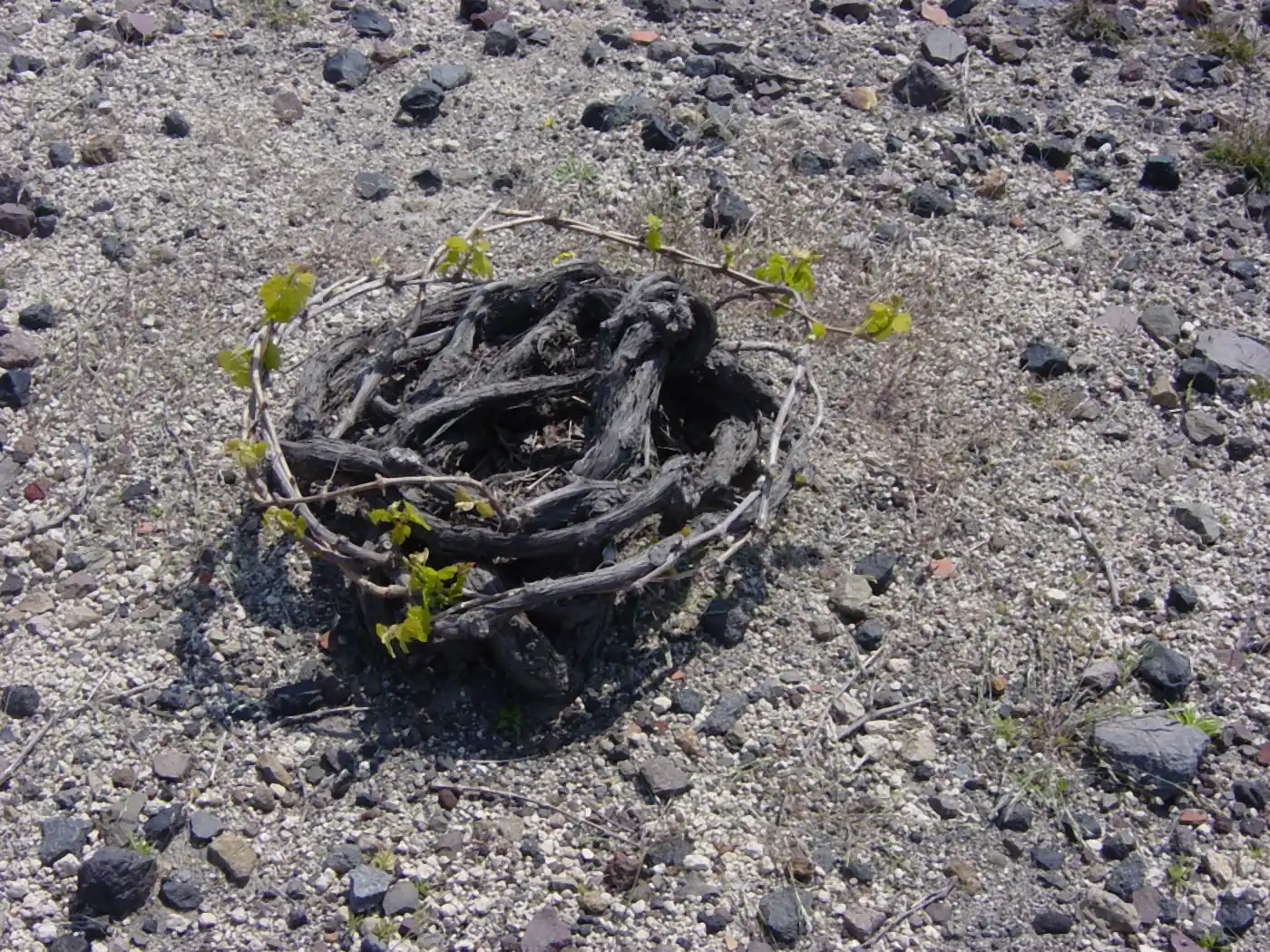
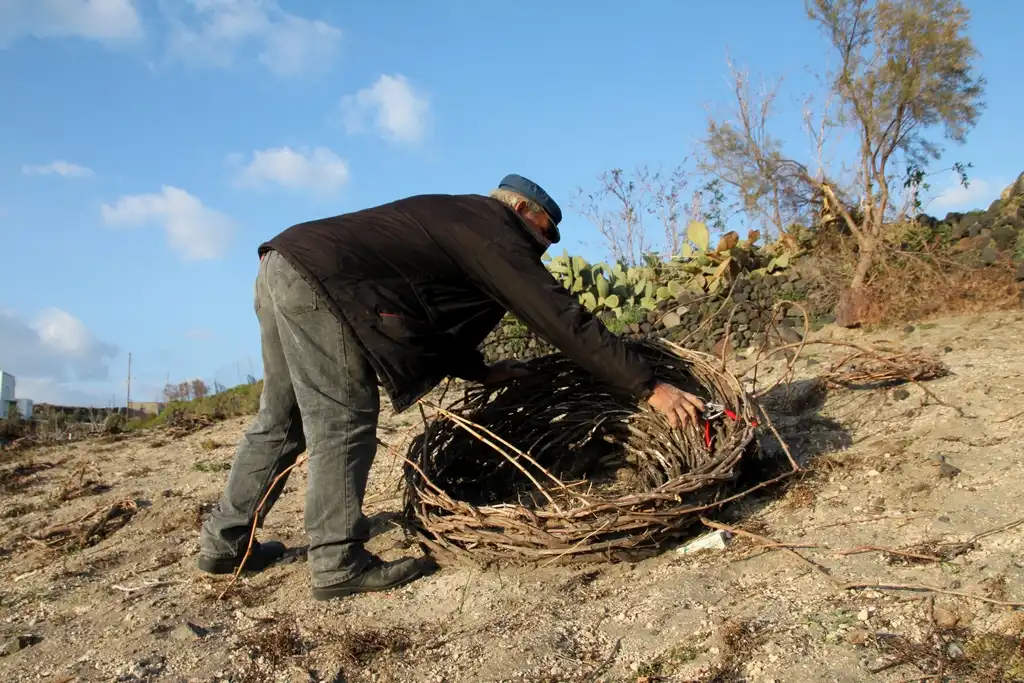
The wind wrote the vineyard's strangest signature. Rather than training vines upward on wires, islanders weave each plant into a low, round basket called the kouloura, with the grapes sheltered inside the coil — three centuries of technique that makes a Santorini vineyard look, to first-time visitors, like a field of green wreaths laid on black sand. It is the single most photographed agricultural object in Greece, and the emblem this site wears as its logo.
The grapes: one king, a fascinating court
Assyrtiko rules roughly three-quarters of the vineyard, and rules the island's reputation absolutely. It is that rare grape that concentrates acidity as it ripens in heat — yielding bone-dry whites of lemon, flint, sea-spray salinity, and a tension that lets the best bottles age fifteen or twenty years. Critics reach for Chablis and Sancerre comparisons; our Assyrtiko chapter unpacks the taste, the food pairings, and the pronunciation (ah-SEER-tee-ko, since you asked).
The court matters too. Athiri and Aidani, the soft-spoken whites, round Assyrtiko's edges in blends and lend Vinsanto its perfume. Mavrotragano, rescued from near-extinction, makes the island's collectible red — dense, peppery, mountain-dark. Mandilaria adds structured, brighter reds; and curiosities like Katsano and Voudomato survive almost entirely in the courtyard of Gavalas, one family's stubborn act of preservation.
The styles: dry, night, and amber
Santorini's signature dry white — labeled simply Assyrtiko or Santorini PDO — is where every tasting starts. The island's second act is Nykteri, the traditional "night harvest" style: grapes picked before dawn and pressed the same day, fermented to higher ripeness, often with a whisper of oak — fuller, warmer, an entirely different register from the same grape. The third act is the island's amber crown: Vinsanto, sun-dried grapes barrel-aged for years into a sweet wine of apricot, caramel, coffee, and — improbably — refreshing acidity. The name is the island's own ("Vino di Santorini" in Venetian trade), and yes, we cover the Italian naming dispute with receipts.
Which Santorini wine should I order first?
Follow the island's own sequence. Start with a dry Assyrtiko — lemon, flint, sea-spray salinity — because it calibrates your palate to the volcanic register everything else plays in. Second glass: Nykteri, the night-harvest style — same grape, fuller and warmer, often with that whisper of oak — so you can taste what ripeness and tradition do to identical ground. Save Vinsanto for last, always: apricot, caramel, and coffee wrapped around acidity that keeps a sweet wine improbably fresh, and a finish that makes everything after it taste thin. And if a list offers a Santorini red — a dense, peppery Mavrotragano above all — order it on sight; so little exists that the chance itself is the recommendation. Three glasses, one island, in the right order.
Three thousand years, five chapters
The short version of a very long story. Chapter one is the Bronze Age: when the great eruption sealed the town at Akrotiri around 1600 BC, it sealed grape seeds, vessels, and winemaking equipment inside — and vines came back into the ash afterward, the beginning of one of the oldest unbroken winegrowing cultures on Earth. Chapter two is trade: under Venetian rule the island's sun-dried sweet wine sailed out under the name that stuck, "Vino di Santorini" — Vinsanto — and became the island's calling card in foreign ports for centuries. Chapter three is the near-miss of the 19th century: while phylloxera tore through the vineyards of France and the mainland, Santorini's sandy volcanic ground never let the louse take hold, which is why the roots under your glass may predate Greek independence.
Chapter four is the near-collapse and the comeback: the 1956 earthquake triggered mass emigration, tourism made building plots worth more than vineyards, and the vineyard shrank drastically — until a revival led by the growers' cooperative (today roughly 1,200 families feeding Santo Wines) and pioneering estates proved the wine could command world prices. The bones of the older industry still stand: Canava Roussos, in cellars from 1836, and Venetsanos, the island's first industrial winery, engineered into the caldera cliff in 1947. Chapter five is the one you can taste this week: the boutique renaissance — organic old-vine purists like Hatzidakis, benchmark estates like Sigalas and Argyros, and newcomers like Vassaltis proving the story is still being written. The full timeline, with the receipts, lives in our history chapter.
Why is Santorini wine so expensive?
Because everything about it is scarce except the demand. The vines are ungrafted centenarians that yield a fraction of what a young commercial vineyard gives; every basket is farmed and picked by hand on waterless volcanic slopes; and the land itself competes with tourism for every square meter. Then the weather weighed in: three drought years cut the 2025 harvest to a final 450–550 tonnes — the smallest on record, against about 2,300 tonnes as recently as 2022. Cellar-door flights that cost pocket change a decade ago now run €18–55, and the trade press has started comparing the island's price trajectory to Champagne's. The wine didn't get fashionable so much as the supply collapsed under a reputation that kept growing — the full arithmetic is in the terroir chapter and the numbers module below.
When is the Santorini grape harvest?
Earlier than almost anywhere in Europe. Picking typically starts in early-to-mid August — sometimes late July for the ripest Assyrtiko parcels — and runs into September, with dawn picks beating the heat and the traditional night harvest giving Nykteri its name. It is also the one season a visitor can step inside the work instead of watching it: our Harvest Days experience runs only in this window, matched week by week to whichever canava is actually picking — cutting clusters from inside the baskets, foot-pressing, and tasting the island mid-vintage. Recent harvests give the season an edge of drama: after three drought years, 2025 brought in a final 450–550 tonnes, the smallest crop on record, and the 2026 picking now underway is forecast smaller still — our harvest report tracks it as the numbers land. Timing the trip? The month-by-month guide weighs harvest energy against summer crowds.
Where should a first-time visitor start?
With a plan, because the doors don't all open the same way. Four cellars — Hatzidakis, Sigalas, Art Space, and Therasia's Mikra Thira — are strictly appointment-only, and summer slots at the popular houses fill days ahead. Walk-in-friendly options exist (Gavalas, Roussos, the Wine Museum, and Santo Wines outside peak hours), and exactly two terraces genuinely face the caldera. Greek drink-driving limits are strict, island taxis are few, and the arithmetic of hiring a driver rarely beats a tour price.
That is the honest case for guided wine tasting in Santorini — and it is also the family business: nine tours with every winery named upfront, from a €95 museum morning to picking the harvest yourself in September. Prefer to self-drive? Our winery comparison guide maps booking policies, 2026 tasting prices, and views for all thirteen doors, no booking required.
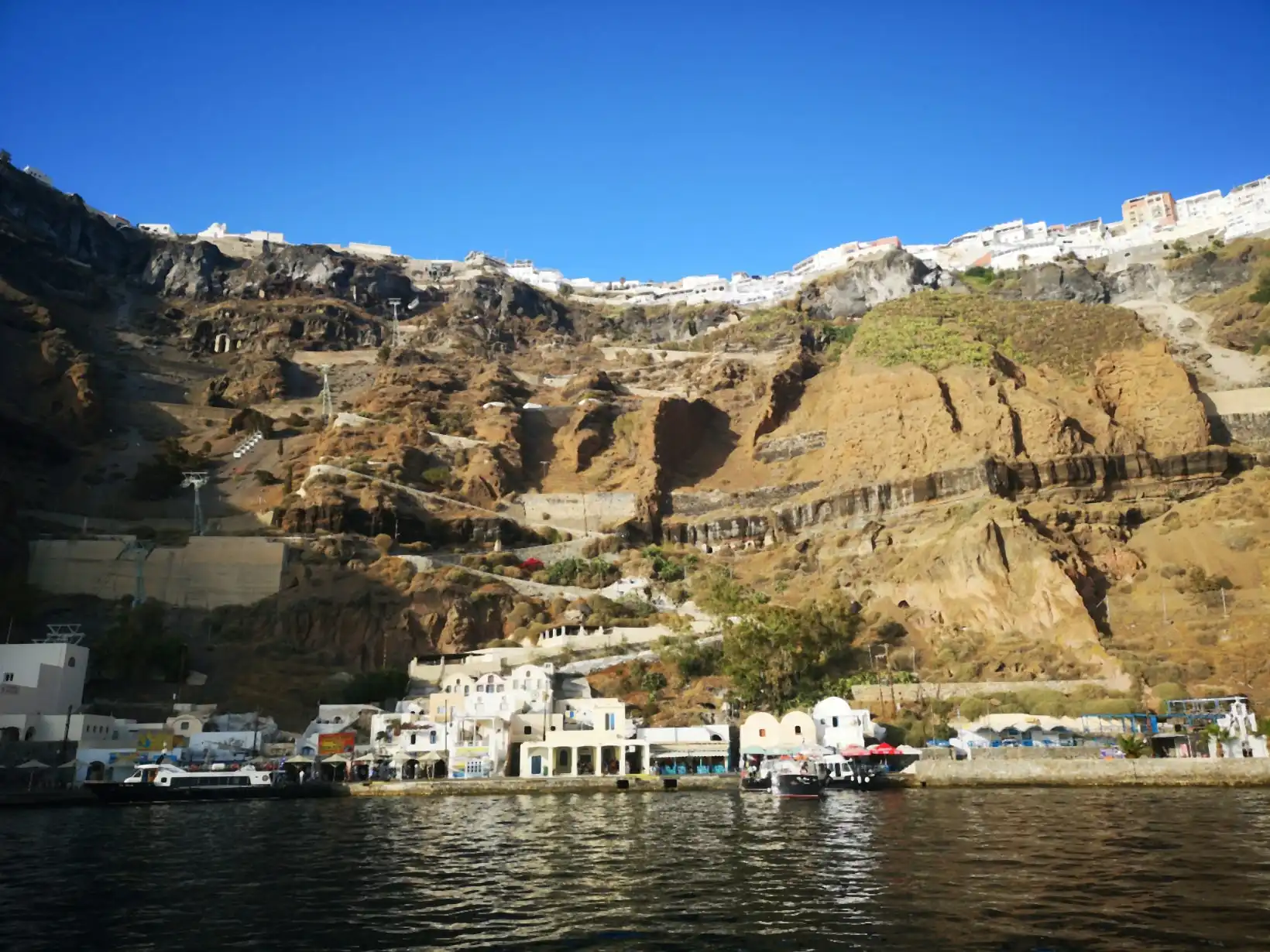
Fira's caldera wall — the strata this guide keeps talking about, readable from the old port
Santorini wine, by the numbers
Eight figures that explain everything
- 3,000+
- 3,000+
years of continuous winemaking — among the oldest uninterrupted wine cultures on Earth, predating the Roman Empire by a millennium
- ~1,200
- ~1,200
grower families in the island cooperative; roughly half of every harvest flows through Santo Wines
- 450–550 t
- 450–550 t
the final 2025 harvest after three drought years — versus ~2,300 t in 2022, ~850 t in 2023, ~700 t in 2024 — and mid-harvest forecasts put 2026 lower still. A crisis, and a masterclass in scarcity
- 70–200 yrs
- 70–200 yrs
typical age of the ungrafted vines; Estate Argyros farms parcels planted before Greek independence
- 0
- 0
times phylloxera has survived Santorini’s sandy volcanic soil — the vines have never needed American rootstock
- 2
- 2
wineries with a true caldera view (Santo Wines, Venetsanos) — despite what every brochure implies
- €18–55
- €18–55
the 2026 range for tasting flights at the island’s cellar doors; up sharply since 2023
- 13
- 13
wineries a visitor can meaningfully experience, all profiled in our winery guide
Figures compiled from producers' own published data, competition records, and trade-press harvest reporting, verified August 2026. Quote us — a link home is the only toll.
The cellar dictionary
Twelve words you'll hear in every canava
The working vocabulary of a Santorini tasting, in plain English. You'll meet these words all over this site — wherever one carries a dotted gold underline, tap it and the definition follows you there.
- kouloura
- The Santorini basket vine: each plant is woven into a low coil so the grapes ripen inside, sheltered from wind and blowing pumice. Three centuries of technique — and the emblem this site wears as its logo. Read the chapter
- canava
- A traditional Santorini winery — originally a cave or barrel-vaulted cellar cut into the volcanic rock, where wine was pressed and aged. Many of the island’s modern tasting rooms still sit inside one.
- Assyrtiko
- Santorini’s flagship white grape — bone-dry and mineral, all lemon, flint, and sea-spray salinity, with acidity that lets the best bottles age for two decades. Pronounced ah-SEER-tee-ko. Read the chapter
- Nykteri
- The “night harvest” style: Assyrtiko picked before dawn and pressed the same day, fermented to higher ripeness — fuller and warmer than the classic dry white, often with a whisper of oak. Read the chapter
- Vinsanto
- The island’s amber crown: sun-dried Assyrtiko, Athiri, and Aidani, barrel-aged for years into a sweet wine of apricot, caramel, and coffee held fresh by improbable acidity. Read the chapter
- vedema
- The Santorini grape harvest — among Europe’s earliest, typically starting early-to-mid August, with dawn and night picking to beat the heat.
- caldera
- The flooded volcanic crater at Santorini’s center, rimmed by cliffs that hold Fira and Oia. Exactly two winery terraces genuinely face it — fewer than the brochures imply.
- Mavrotragano
- A rare Santorini red grape rescued from near-extinction — dense, peppery, mountain-dark, and now the island’s collectible red. If a list offers one, order it on sight.
- Aidani
- A soft, aromatic Santorini white — Assyrtiko’s traditional blending partner, lending perfume to island whites and to every classic Vinsanto.
- Athiri
- A gentle island white grape that rounds Assyrtiko’s sharp edges in blends and joins it in traditional Vinsanto.
- phylloxera
- The root louse that forced most of Europe’s vineyards onto American rootstock in the 19th century. It has never survived Santorini’s sandy volcanic soil — the island’s vines still grow on their own roots. Read the chapter
- PDO
- Protected Designation of Origin — the EU appellation system. A “Santorini PDO” label guarantees the grapes grew on the island under its rules, from permitted varieties led by Assyrtiko.
Good to know
The three questions every guest asks first
What is Santorini's most famous wine?
Assyrtiko — the bone-dry volcanic white that critics rank with Chablis and Sancerre among Europe’s great mineral wines. Close behind stands Vinsanto, the amber sun-dried dessert wine whose name the island lent to history. Nykteri, the traditional night-harvest style, completes the signature trio.
Does Santorini make red wine?
Yes, in small quantities. Mavrotragano — once nearly extinct, now the island’s prestige red — makes dense, spicy wines, while Mandilaria yields brighter, structured reds and Voudomato survives almost solely at Gavalas. Whites dominate the vineyards, but a Santorini red is worth ordering whenever you see one.
Why is Santorini wine so expensive?
Arithmetic, not fashion: ungrafted centenarian vines yield a fraction of normal vineyards, everything is farmed and picked by hand on waterless volcanic slopes, land competes with tourism development, and three drought years cut the 2025 harvest to a historic low. Trade press now compares price trajectories to Champagne — supply is the whole story.
Reading about wine is the appetizer
The cellars, the baskets, and the amber verticals are 15 minutes from Fira. Join a small-group tour — every winery named, every fee included — and taste the whole syllabus.