Harvest report
Santorini Harvest Report 2026: the smallest vedema yet?
The 2026 Santorini harvest opened with the Vedema festival on August 2; Mavrotragano came in first, and the main Assyrtiko picking started just after August 15 — about four days later than 2025. Mid-harvest forecasts range from roughly 300 to 450 tonnes, which would make 2026 the smallest Santorini vintage ever recorded.
By Nikolas, traditional Santorini winemaker ·
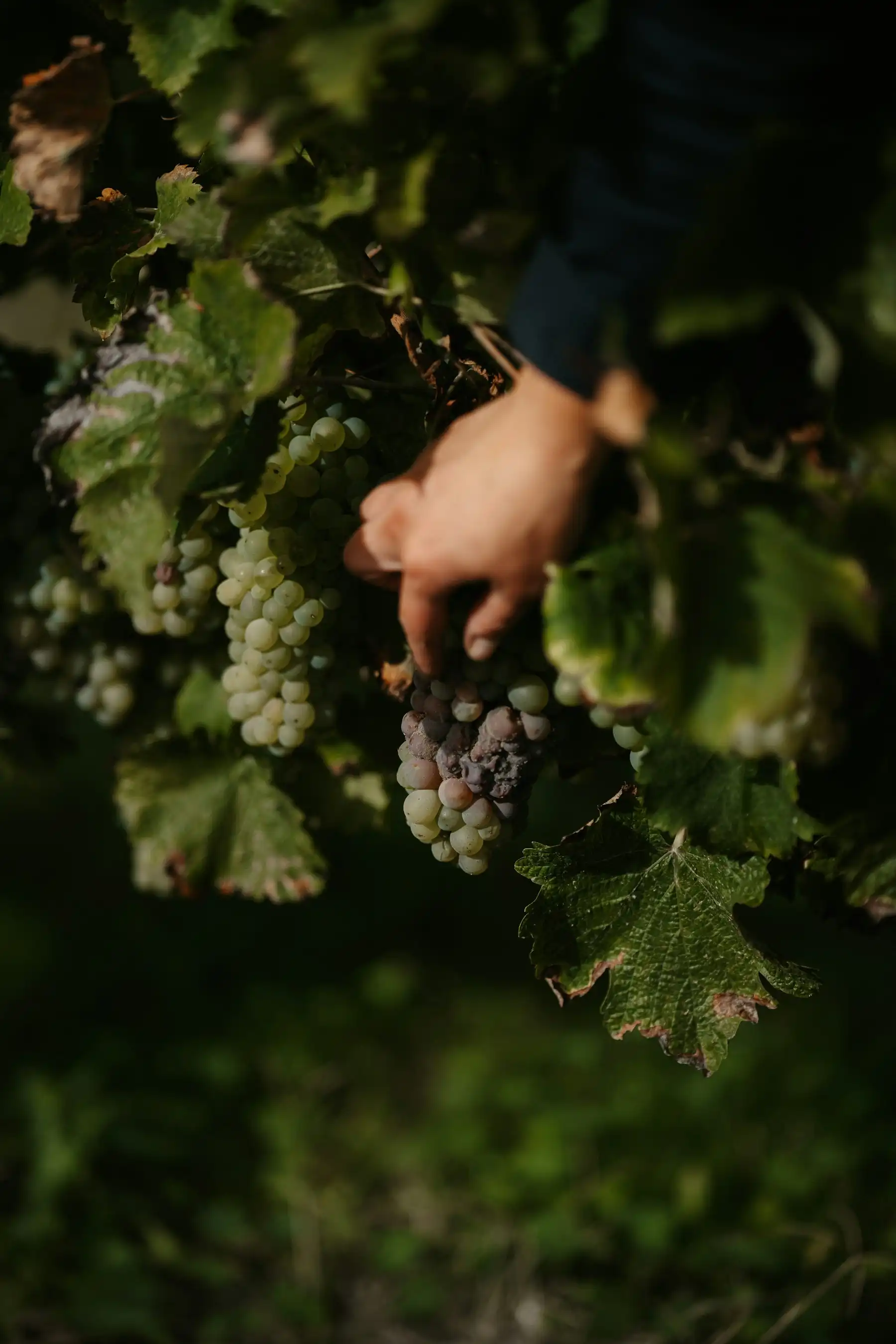
I am writing this at the end of August, which on Santorini means writing between loads of grapes. The The Santorini grape harvest — among Europe’s earliest, typically starting early-to-mid August, with dawn and night picking to beat the heat. — the island’s harvest — is the one stretch of the year when the wine stops being a product and becomes what the whole island is visibly doing: crates at the field edges before sunrise, trucks idling at cellar doors, must on everyone’s shoes. This report gathers what is actually known about the 2026 vintage so far, with sources, and will be updated when the final numbers land in September.
The short version: it started late, it will almost certainly be the smallest harvest anyone has ever measured here, the fruit is fetching prices no Greek vineyard has ever seen — and the wine, stubbornly, keeps being excellent.
How did the 2026 harvest start?
The season opened the way it always does: with the Vedema festival at Santo Wines in Pyrgos on Sunday, August 2 — harvest reenactment, grape treading, folk music, free to walk into if you happened to be on the island. The festival is ceremony rather than logistics; the real picking follows its own clock.
That clock ran late this year. Mavrotragano — the rare red, always among the first fruit in — came off in the first half of August, and the main event, Santorini’s flagship white grape — bone-dry and mineral, all lemon, flint, and sea-spray salinity, with acidity that lets the best bottles age for two decades. Pronounced ah-SEER-tee-ko., started just after August 15: about four days later than 2025, by wine analyst Yiannis Karakasis MW’s accounting. For reference, 2025 ran August 7–27 winery-by-winery; a mid-August Assyrtiko start pushes the tail of this vintage well into September.
Late is not automatically bad. But the reasons behind it are the same ones behind everything else in this report: a winter that never got properly cold or wet, spring windstorms that punished the young shoots, and a vineyard still carrying three years of drought in its wood.
How small will 2026 be?
Nobody has a final number yet — picking is still underway — so here is the honest state of the forecasts, with dates:
| Vintage | Island total | Status |
|---|---|---|
| 2022 | ~2,300 t (some counts up to ~2,750 t) | final |
| 2023 | ~850 t | final |
| 2024 | ~650–700 t | final |
| 2025 | 450–550 t, depending on who counted | final |
| 2026 | ~300 t (Karakasis MW, Aug 8) to 400–450 t best case (Greek financial press, Aug 14) | forecast |
Karakasis, writing on August 8, projected a fall of up to 30% below 2025 — from roughly 450 tonnes to “slightly over 300” — with some parcels giving an almost unthinkable 30–70 kilos per stremma. Six days later the financial daily Oikonomikos Tachydromos put the ceiling at 400–450 tonnes “in the best case”, against roughly 2,500 tonnes as recently as 2020 — a collapse of more than 80% in six years.
Either number would set a record below last year’s record. When the finals publish — Santo Wines and Domaine Sigalas both issue September harvest reports — this table gets updated the same week.
Why does the island keep losing wine?
Because the vineyard is thirsty, hot, and shrinking, in that order.
The weather first. The 2025–26 winter was unusually warm and dry on an island that farms without irrigation and effectively without rain; spring then added windstorms that stressed the vines further. That landed on ground already exhausted: researchers quoted by Reuters this June note that 2023–24 brought the highest temperatures this vineyard has seen in six decades, and old dry-farmed vines have begun simply dying — Sigalas’s Yiannis Boutaris described a ninety-year-old basket vine that shriveled and did not come back.
Then the arithmetic. Santorini grapes now trade around €10 per kilo — against well under €1 in northern Greece — and Santorini wine prices have roughly doubled in five years without denting demand; wineries report selling out regardless. Meanwhile the vineyard itself has contracted from some 30,000 stremmata decades ago to around 12,000 registered today, of which likely fewer than 10,000 are truly farmed — land under vines is worth far more under hotels, and some growers have simply walked away from parcels the drought made pointless.
Scarcity on top of scarcity: fewer stremmata, giving less fruit, at higher prices. That is the whole crisis in one sentence, and it is why our wine guide’s numbers module reads the way it does.
What are the wineries doing about it?
More than despairing, which is the encouraging part of this report.
The replanting is real: Domaine Sigalas has put in 170 stremmata of new vineyard since 2020, Estate Argyros has replanted more than 500 stremmata of growers’ parcels, and Greece’s national vineyard-restructuring program opened its 2026–27 application window this July for exactly this kind of work. The water experiments are real too — Sigalas is piloting irrigation with recycled wastewater from homes and hotels, plus atmospheric water harvesting with hydrogels and solar power, while other growers lay subsurface drip lines to cut evaporation to nothing. On an island whose whole legend is dry farming, these are quiet revolutions, and Karakasis reports growers and wineries have begun organizing a joint initiative on grape pricing, water, and the protection of the old dry-farmed parcels — details still emerging.
None of this refills the tanks this year. All of it decides whether there is a vintage worth reporting in 2036.
Is the quality holding?
By every signal available — yes, conspicuously. At the 2026 Decanter World Wine Awards Santorini collected 26 distinctions, including two Best in Show: Estate Argyros’s The island’s amber crown: sun-dried Assyrtiko, Athiri, and Aidani, barrel-aged for years into a sweet wine of apricot, caramel, and coffee held fresh by improbable acidity. Late Release 2005 and Santo Wines’ Kontarades 2024. The president of the Greek Wine Association put it plainly in August: whatever else is collapsing, the wines have kept “a very high level.”
That tracks with what a tiny, stressed crop does: less juice, more concentration. It also tracks with what your glass will cost, which brings us to the practical part.
What does this mean for your visit — and your cellar?
If you are on Santorini now through mid-September: you are here during the most dramatic vintage in the island’s modern history, and you can stand inside it rather than photograph it — Harvest Days runs only while the picking does, matched weekly to whichever A traditional Santorini winery — originally a cave or barrel-vaulted cellar cut into the volcanic rock, where wine was pressed and aged. Many of the island’s modern tasting rooms still sit inside one. is actually cutting fruit. Dawn picking, foot-pressing, and the harvest table; in a 300-tonne year, the conversation around that table writes itself.
If you are planning ahead: harvest energy versus summer crowds is a real trade-off — the month-by-month guide weighs it honestly. The February 2025 earthquake swarm, for the record, damaged tourism confidence rather than vines; seismic activity normalized by mid-2025 and no source we can find documents any vineyard or winery damage.
If you love these wines: buy them when you see them. Between record-low volumes, €10/kg fruit, and wineries selling through their stock, allocation — Champagne-style — is no longer a metaphor here. A bottle of Assyrtiko from these drought vintages is a bottle of weather history; the Vinsanto being pressed this month will outlive everyone reading this.
Sources and updates
Reported against: Yiannis Karakasis MW (Aug 8, 2026), Oikonomikos Tachydromos (Aug 14, 2026), Reuters via Greek Reporter (Jun 29–30, 2026), the Vedema festival program (santorini.net), the Domaine Sigalas harvest reports, and the 2026 Decanter World Wine Awards coverage — all linked in place above. Figures for 2022–2025 follow the source spread noted in the table rather than false precision.
No final 2026 volume or producer quality verdict exists as of this writing. Both are expected in September; this page will carry them, with a visible updated date, the week they publish. Quote us with a link — and if you are a journalist working this story, our press page has the fact sheet and a direct line.
Good to know
Questions travelers ask
When did the 2026 Santorini grape harvest start?
The season opened ceremonially with the Vedema festival at Santo Wines on August 2, 2026. Mavrotragano was picked first, in the first half of August, and the main Assyrtiko phase began just after August 15 — about four days later than in 2025, after a warm winter and a stormy spring.
How big will the 2026 Santorini harvest be?
No final figure exists yet. Forecasts published mid-harvest range from just over 300 tonnes (Yiannis Karakasis MW, August 8) to 400–450 tonnes in the best case (Greek financial press, August 14). Any figure in that range would be the smallest harvest ever recorded on the island, below 2025's final 450–550 tonnes.
Can visitors still join the 2026 harvest?
Yes — picking runs into September, and our Harvest Days experience places guests inside a working vintage while it lasts: cutting fruit from the kouloura baskets at dawn, foot-pressing in the patitiri, and tasting with the family that grew the grapes. In a year this scarce, every crate genuinely matters.
Check dates and availability
Tell us your dates and party size — we confirm availability within a day, usually much faster on WhatsApp. Free cancellation up to 48 hours before your tour.