Santorini Wine Guide
Kouloura: Why the Vines Grow in Baskets
Santorini's vines are woven into low, round baskets — the kouloura — because the island's fierce winds and near-total lack of rain would destroy conventionally trained vines. The living wreath shelters grapes inside its coil from wind, sun, and blowing pumice, while the low form harvests night humidity. It's centuries-old aerodynamic engineering, done by hand, plant by plant.
By Nikolas, traditional Santorini winemaker · Updated:
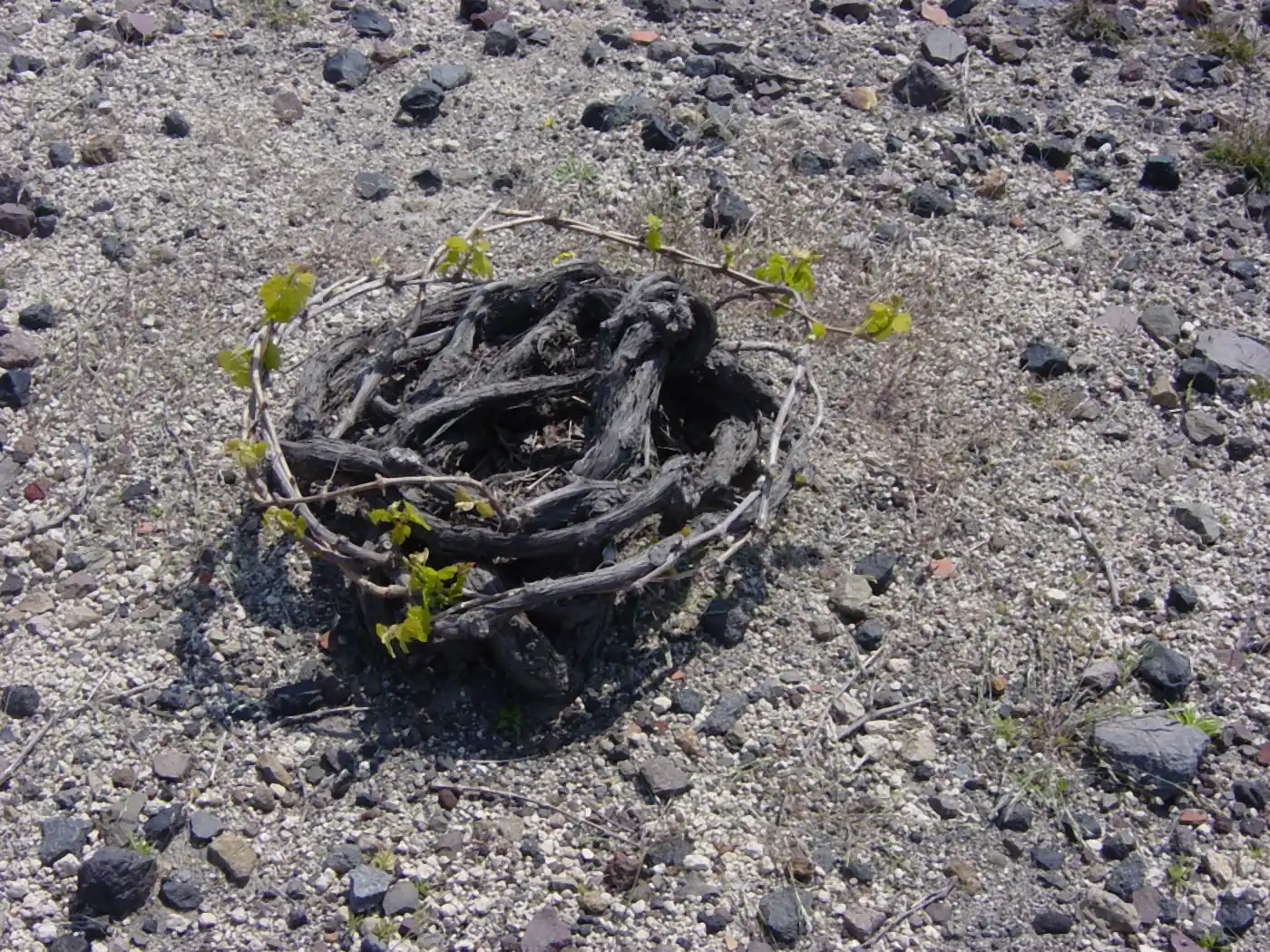
The strangest vineyard view in the world
First-time visitors driving the island’s inland roads routinely fail to recognize the vineyards at all. There are no green walls of trellised vines, no neat wired rows — just dark, pebbly fields scattered with what look like woven wreaths someone laid on the ground and forgot. Then a field worker kneels, lifts a coil’s edge, and pulls out a cluster of grapes: every “wreath” is a living vine, trained around itself into a basket with the fruit growing inside.
This is the kouloura, and it is not decoration, folklore, or Instagram bait (though it has become all three). It is precision agricultural engineering for an environment that kills vineyards, refined over centuries and still done entirely by hand — the practice we put at the center of our own logo, because nothing else on Earth says Santorini as instantly.
Three problems, one elegant answer
Wind. The summer meltemi runs down the Aegean hard enough to strip a trellised vine of leaves, snap green shoots, and sandblast fruit with airborne pumice. The kouloura presents a low, round, aerodynamic profile the wind slides over — and the grapes ripen in the sheltered eye of the coil, untouched.
Sun. Cloudless Cycladic summers would scorch exposed clusters into raisins by July. Inside the basket, the vine’s own canopy becomes a parasol: dappled light, no burn, slow even ripening — exactly what a high-acid grape like Assyrtiko needs to stay electric.
Thirst. Santorini has no rivers, no springs, and rainfall that would qualify as a rounding error in most wine regions. What it has is night humidity — sea mist that condenses on and around the low coils and soaks into the volcanic soil that holds it like a sponge. Hugging the ground turns the whole plant into a dew-collection device. The kouloura doesn’t survive the drought; it harvests the air.
A craft measured in generations
No machine weaves a kouloura. Every winter, growers prune and hand-train each vine’s canes around the circle — a skill learned from parents, done kneeling, across thousands of plants. A well-kept basket works for decades; when it finally tires (after 40–80 years), the grower cuts the visible coil away and starts a fresh weave from the same rootstock — roots that, The root louse that forced most of Europe’s vineyards onto American rootstock in the 19th century. It has never survived Santorini’s sandy volcanic soil — the island’s vines still grow on their own roots. having never conquered this sand, are commonly 100 and sometimes 200 years old. The visible vineyard is mortal; the vineyard underneath is close to eternal.
The price of all this is yield. A kouloura vine gives a fraction of what trellised vineyards produce — one respectable reason Santorini wine costs what it costs, and the entire reason the flavors concentrate the way they do.
Where to meet the baskets properly
You’ll glimpse kouloura fields from any island road, but the difference between seeing and understanding is a guide with a vine in hand. Every one of our land tours stops among the baskets long enough for the demonstration; Domaine Sigalas offers garden tastings literally surrounded by them, and the deepest version is seasonal: on Harvest Days you kneel at the coil, reach inside, and cut the fruit yourself — at which point the odd little wreaths stop being quaint and reveal themselves as what they’ve always been: the smartest response to wind, sun, and thirst that any vineyard culture ever wove.
Why do Santorini vines grow in baskets?
Santorini’s growers weave each vine into a low circular wreath — the kouloura — because nothing trained upright would survive this island. The summer meltemi blows hard enough to snap young shoots and pepper fruit with flying pumice; the coil gives the wind a rounded shape to spill over while the grapes ripen sheltered inside it. The relentless Cycladic sun, which would scorch exposed clusters, filters instead through the vine’s own canopy. And on an island with almost no rain, the ground-hugging form gathers the night humidity that drifts off the Aegean and sinks into the spongelike volcanic soil beneath. Each basket is pruned and rewoven by hand every winter; when a coil finally tires, a new one is trained from the same roots — often 100 to 200 years old, because phylloxera never survived this sand. Yields are tiny, flavors concentrated, and every tour we run stops among the baskets to show you why.
Good to know
Questions travelers ask
Why are Santorini's vines grown in baskets?
Defense, on three fronts: the meltemi wind that would snap upright vines and sandblast grapes with pumice; a brutal sun that would scorch exposed fruit; and drought — the low coil traps the night humidity that is effectively the island's only irrigation. The basket is the grape's bodyguard.
What do 'kouloura' and 'kladeftiko' mean?
Kouloura means 'coil' or 'wreath' — the classic closed-basket weave with grapes hidden inside. Kladeftiko refers to the related pruning-and-weaving practice; you'll hear both terms at cellar doors, sometimes interchangeably. Either way, it's done entirely by hand, one vine at a time, every winter.
How old do the basket vines get?
The root systems commonly reach 70–200 years — phylloxera never survived the volcanic sand, so vines were never torn out and regrafted. The visible basket is rewoven across decades: when a coil tires after 40–80 years, growers cut it back and train a new shoot from the same ancient root.
Keep exploring
Related reading
Taste what you just read about
Every fact in this guide comes from the cellars we visit weekly. Join a small-group tour and taste Assyrtiko, Nykteri, and Vinsanto where they're made.